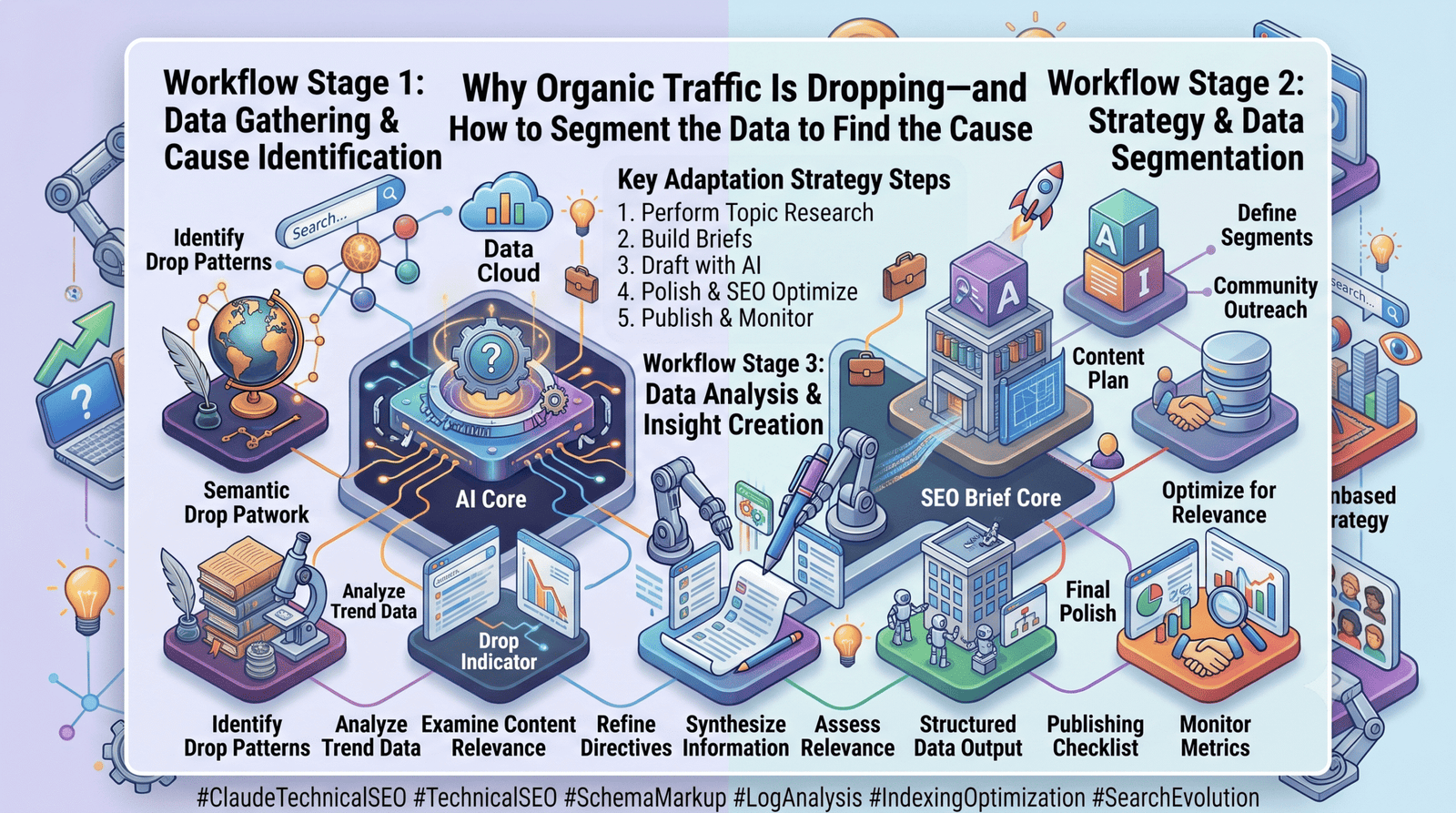
- Over the years, the organic traffic is dropping, and for several businesses, that realization has created instant panic. A traffic decline is not random, but it is usually a signal and the fastest way to understand that it is about time to segment your data properly. When organic traffic is dropping, most individuals look at one graph or total sessions, and then they assume that the entire website is in trouble, which is rarely the case.
- There are some critical details hidden in the aggregate data, and your performance can be pulled by a single high-tariff blog post that is losing its ranking, a mobile-issue that disrupts your website performance, or a drop in one country. Without proper segmentation, you may think that your whole SEO strategy has failed, but in reality, the problem has only isolated. The main principle is to remember that organic traffic is dropping for a reason, and that the reason is always presented within a specific segment of data.
Common reasons why your organic traffic is dropping
- Organic traffic drop usually occurs from changes in the algorithm, site issues, or problems in content, however diagnosing the exact cause will require you to use tools such as Google Search Console. You can also opt for SEO professional services or use a content marketing guide in order to fix the problems related to your content.
Algorithm updates
- The core updates of Google, such as the March 2024 version, usually target low-quality or AI-generated content that has caused widespread deindexing and traffic loss. Recent shifts has also emphasized the E-E-A-T (experience, expertise, authoritativeness, and trustworthiness), so review your content accordingly.
Content problems
- If your website has duplicate content, outdated pages, poor quality, or ignores user intent, then it will lead to a loss in ranking. Zero-click searches as well as AI Overviews (now in more than 47% of results) have reduced clicks, especially for informational queries.
Technical issues
- If your website has slow page speeds, crawl errors, broken links, or blocking CSS/JS in robots.txt, which prevents proper indexing, reducing the overall traffic ranking. Site migrations and redesigns without 301 redirects or mobile-unfriendly designs also lead to drops in organic ranking.
How to segment data to find the cause of why organic traffic is dropping
Step 1- Segment traffic by time period
- The main step is to diagnose why organic traffic is dropping, and to understand when the drop started. For this, you can compare two clear timeframes. These areas are:
- A stable time period before the decline started
- The period after the traffic started to drop
- In this, you need to search for
- Sudden drops, which are often linked with algorithm updates and technical changes
- Gradual declines, which usually indicate decay in content or competitive pressure
- Match the timing with
- The update dates of the Google algorithm
- Website changes like the redesigns, migrations, or URL updates
- If the organic traffic has dropped suddenly after a particular date, you have already narrowed down the problem significantly.
Step 2- Segment the landing pages
- The next step is to evaluate which landing pages are losing traffic. This is one of the most critical steps to understanding why organic traffic is dropping,
- You can segment the pages into categories like:
- Blog articles
- Service or product description pages
- Category or even pillar pages
- Now you can ask key questions:
- Is the drop in ranking site-wide or limited to only specific pages?
- Are the older blogs post loosing traffic faster than the new ones?
- Are high-conversion pages impacted or only the pages with informational content?
- Most of the time, organic traffic is dropping because a handful of high-performing pages have lost their rankings, and not because your entire website declined.
Step 3- Segment by keywords and search queries
- Keyword-level analysis is significant when organic traffic is dropping, especially in competitive niches.
- You can use Google Search Console in order to:
- Recognize queries with declining impressions
- Spot keywords that are losing clicks despite the stable impressions
- Compare the ranking positions before and after the drop
- These are the important keyword segments you need to evaluate:
- Branded vs non-branded keywords
- Informational vs transactional queries
- Long-tail vs high-volume keywords
- If the organic traffic is dropping for the informational queries, then the issue is mostly in the quality of the content or a mismatch in intent. If commercial keywords are impacted, competition or SEO changes are to blame.
Step 4- Segment by device type
- Some organic traffic is dropping only on specific devices, especially mobile devices
- For this, you need to compare:
- Desktop traffic
- Tablet traffic
- Mobile traffic
- Common and mobile-specific causes consist of:
- Poor core web vitals
- Slow-loading pages
- Mobile usability errors
- As Google mainly uses mobile-first indexing, even small mobile issues can actually lead to a drop in organic traffic.
Step 5- Segment by location
- If your website serves in various countries or regions, then geographic segmentation is necessary.
- For this, you need to check whether the organic traffic is dropping:
- Globally
- In only specific countries
- In selected regions
- Country-specific declines are usually caused by:
- The local competitors have improved their SEO
- Localization issues are present in your website’s content
- Region-specific algorithm updates
- Incorrect hreflang implementation
- For international websites, the drop in organic traffic for just one country is usually a strong technical or localization signal.
Step 6- Segment by indexing and technical SEO status
- The last step is to segment your website data by indexing and technical SEO status. When your organic traffic is dropping, you need to always check whether the search engines can still access and index your pages:
- Here are the key areas that you need to review:
- Indexed vs non-indexed pages
- Noindex tags that are added accidentally
- Robots.txt blocking important URLs
- Even a small technical misconfiguration can lead to an organic traffic drop, especially after major site updates or CMS changes
Conclusion
- When organic traffic is dropping, the worst response of a website owner is to panic, and the best response is precision. Traffic delays are symptoms, and not the problem; the real issue is always present in your data, which is waiting to be uncovered through segmentation. This is where expert support creates a difference. At Pentra SEO services, we specialize in diagnosing organic traffic declines mainly through advanced segmentation, content performance analysis, and technical audits. From recognizing loss in ranking to fixing technical bottlenecks and refreshing the underperforming content, Pentra SEO services are directly aligned with the strategies discussed in the blog.
- Contact us today, and our team will get back to you in 24 hours.

Author
Pentra SEO Agency