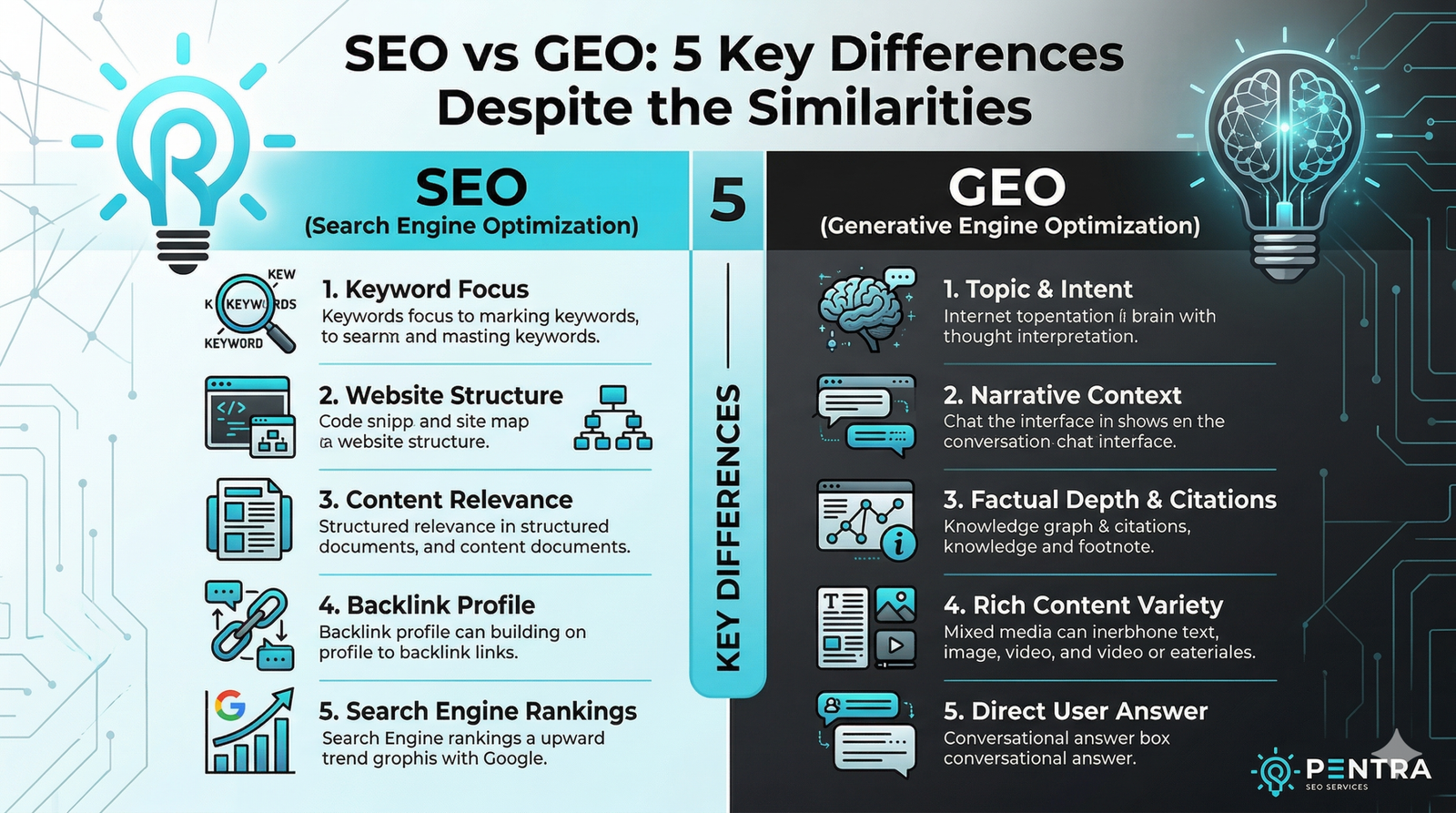
- SEO vs GEO has become one of the most discussed topics in the digital marketing space, as businesses are trying to understand which strategy is considered to be more effective for visibility and conversions. Many companies depend on SEO professional services or follow a strong content marketing guide to enhance their search rankings, but brands usually get confused when they hear about GEO or even geographical optimization. While the two strategies may appear similar at first glance, they function differently and also cater to the different marketing objectives. This blog explores the five major differences between SEO and GEO, which help businesses choose the right strategy on the basis of their goals.
What is SEO?
- SEO or search engine optimization is the practice of optimizing a website or webpage to enhance its visibility and ranking in unpaid search engine results. The main aim of SEO is to assist search engines in understanding the content of a website better and connect it with users who are searching for relevant information, services, or products. SEO generates qualified traffic to a website by ranking the website higher in search engine result pages (SERPs) for keywords that are relevant to the target audience. It is through SEO that a website can increase organic traffic, foster trust and credibility, and support business goals such as conversions and sales.
What is GEO?
- GEO is an acronym for Generative Engine Optimization. It is the process of optimizing the content of a website mainly for AI-driven search engines such as ChatGPT, Gemini, and Google AI overviews. The main focus of GEO is on making content highly accessible, contextually relevant, and easy to understand for the generative AI platforms, so that the content is used in AI-generated responses. While GEO is similar to traditional SEO in terms of visibility, goals, keyword strategy, technical optimization, and quality of content, it still differs in terms of optimizing for AI systems that synthesize and produce answers instead of a list of links.
Why SEO and GEO seem similar?
- SEO vs GEO often seem similar as both of these focus on increasing the online visibility of your content and also generate traffic or engagement to your website by optimizing content. Both of these have the same foundational principles, like clarity, authority, structure, and responding to user intent. However, their main differences arise from the social environments they target and how they attain their goals.
Difference 1- Targeting scope
- SEO focuses on a wide spectrum of users on the basis of their search intent despite of their physical location. It focuses on improving visibility organically on traditional search engines such as Google and Bing by optimizing content for keywords, backlinks, and site authority in order to achieve higher rankings on search engine pages.
- GEO revolves around geographic targeting, focuses on delivering content, ads, and promotions to user on the basis of their real-time physical location. GEO uses data such as users’ IP addresses, wi-fi signals, and GPS in order to reach users in specific cities, areas, and neighborhoods.
Difference 2- Tools and techniques used
- SEO mainly depends on search-focused tools like:
- Google Keyword Planner
- Ahrefs
- Buzzstream
- Google Search Console
- Surfer SO
- Google My Business
- These tools help in content optimization, keyword research, local SEO, backlink evaluation, and link building.
- GEO depends on:
- Google Ads
- Facebook ads
- Clearscope
- SEO.ai
- While SEO techniques consist of optimizing metadata, content structure, and backlinks, GEO strategies focus on user proximity and real-time behavior. For instance, a user who is walking near a store may get a location-based notification. Which is not achievable by SEO alone.
Difference 3- Intent and user behavior
- SEO strategies focus mainly on understanding user intent, which has multiple types. These types are informational (looking for knowledge). Transactional, (ready to take action), commercial investigation (researching before purchase), and navigation (looking for a specific site). Effective SEO aligns content on the basis of these intents to fulfill user expectations and improve engagement.
- SEO focuses on user behavior signals like bounce rate, time spent on one page, pages per session, as well as conversion rate to understand how well content is performing., For instance, a low bounce rate and longer time spent on page showcase relevance and deeper engagement.
- GEO focuses on user behavior based on their location. It provides relevant information to users on the basis of their physical presence and location history. GEO mainly focuses on micro-moments like the searches that start with “near me” or local needs, which focus on immediate, context-aware responses that generate nearby conversions.
- In GEO, user engagement is usually transactional or immediate action-focused, like visits to stores, local service bookings, and regional promotions.
Difference 4- Content personalization and delivery
- SEO personalization depends on audience data such as demographics, browsing behavior, search history, and location in order to segment users and personalize their content accordingly. Tools that are used in SEO are Google Analytics, and personalization platforms such as HubSpot and Dynamic Yield, which help to create dynamic content that changes in real-time on the basis of users’ needs.
- GEO’s main focus is on structuring the content in order to be authoritative, it is easily understood by AI, and is aligned with the EEAT principles. GEO mainly uses schema markup, entity recognition, and well-organized, precise answers in order to optimize how AI systems read and repurpose a website’s content.
Difference 5- Outcomes and measurement
- SEO outcomes are focused on improving organic search traffic, higher keyword rankings, better visibility on search engines, increased conversions, and better user engagement. Measurements is done through the overall metrics such as organic traffic volume, keyword ranking positions, bounce rate, session durations, pages per session, and click-through rate.
- For this, tools such as Google Analytics 4, Google Search Console, Ahrefs, and HubSpot are used. ROI is evaluated by comparing investment in SEO campaigns against revenue or leads generated from the organic traffic.
- GEO outcomes are focused on improving visibility within the AI-generated answers, increasing content citation by AI platforms, brand trustworthiness, AI responses, and indirect traffic. Measurement in GEO mainly involves tracking AI answer inclusion, voice search performance, content EEAT signals, and impact on organic search visibility.
- For this, measurement tools usually consist of Google Ads geo reports, Facebook Ads location insights, IP targeting performance metrics, as well as CRM systems that have incorporated local data.
Conclusion
- On coming to the conclusion, SEO vs GEO comparison showcases that although both of these strategies share multiple similarities, they serve different purposes in the context of digital marketing. SEO improves long-term organic visibility, while GEO is focused on hyper-local engagement as well as immediate conversions. For businesses that are looking to maximize their online reach, a combination of these two strategies is usually considered to be an effective approach. This is where Pentra SEO Services can be of assistance. Our team has expertise in SEO strategy and content optimization, ensuring that your brand is gaining visibility both locally and internationally.
- Contact us, and our team will get back to you within 24 hours.

Author
Pentra SEO Agency