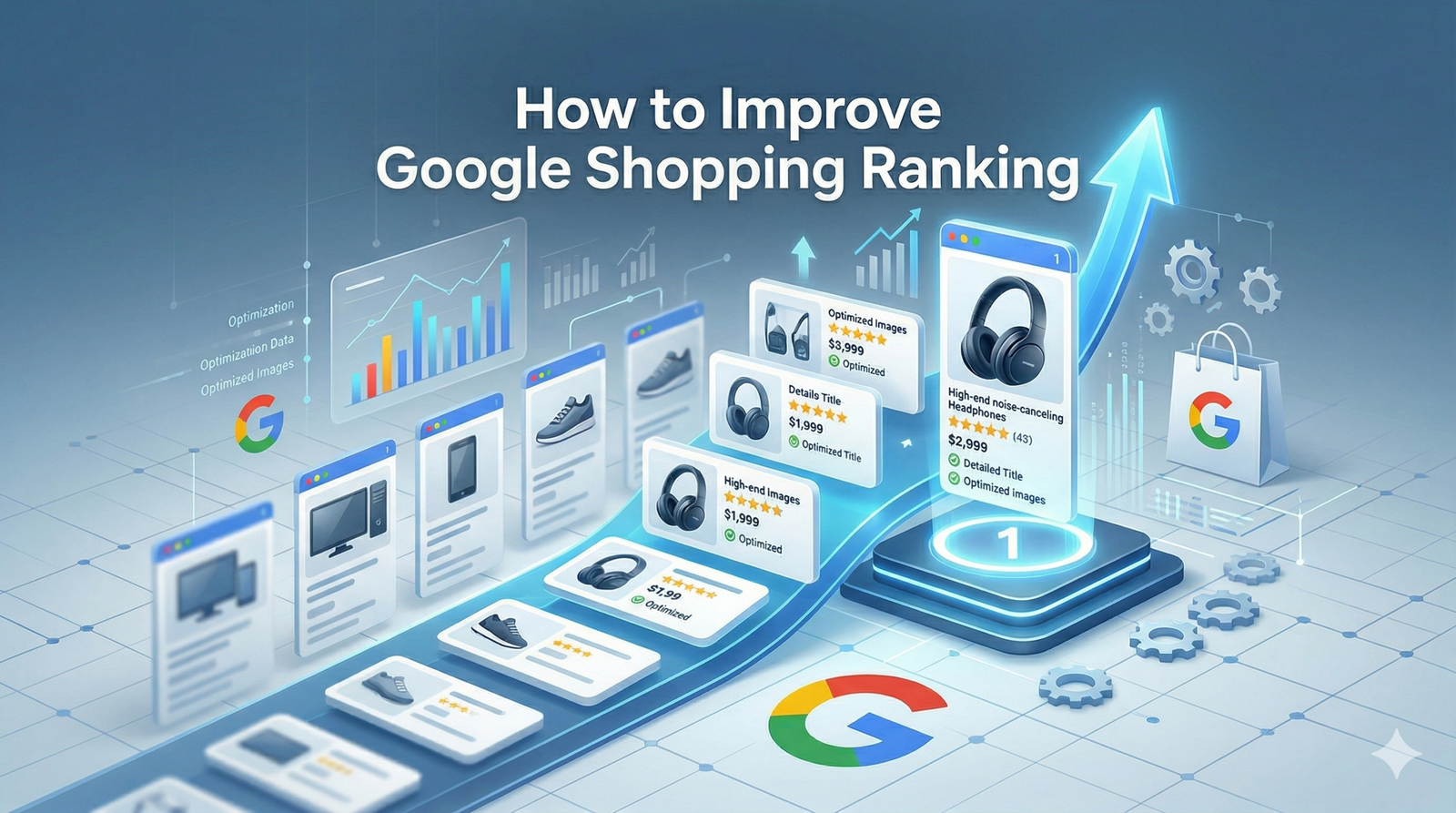
How to Improve Google Shopping Ranking
- Google Shopping ranking has become one of the most significant factors that predict how often a brand’s products appear in front of high-internet buyers, and how much revenue can be generated by an eCommerce store, In the present digital landscape, brands are continuously looking for new ways in order to outperform their competitors, optimize product feeds, and generate more conversions, By using string foundations, such as SEO professional services and following a detailed content marketing guide, businesses can improve their online visibility on Google Shopping and generate sustainable, long-term results.
- Google Shopping ranking has become one of the major channels for e-commerce success. There are visually rich product listings, price comparisons, and even smart recommendations. Consumers depend heavily on Google Shopping in order to make informed decisions about their purchases. In this blog, we will provide the essential steps that will help you to improve your Google Shopping ranking by using optimized product feeds, competitive pricing, and targeted building strategies.
How does Google Shopping ranking work?
- Google shopping ranking works through a difficult set of algorithms that assess multiple key factors in order to determine which products appear higher in search results. The main criteria that impact Google shopping rankings are:
- Product data quality- Accurate and complete error-free product feeds that are submitted through Google Merchant Center help Google to understand the product better and enhance its ranking potential.
- Store quality scores- Google evaluates stores on multiple aspects such as shipping speed, return policies, and the quality of the website. Stories that have exceptional or great scores in these areas ran better, especially in the top positions.
- Product relevance- Products that easily match the search query of users, along with keywords and intent, are prioritized by Google. This consists of optimizing the product titles, descriptions, and even attributes with relevant keywords in order to enhance visibility.
Better product descriptions with relevant keywords
- The search algorithm of Google scans product titles along with descriptions in order to find relevant matches with user search terms. Brands, when they include relevant and specific keywords naturally into their product descriptions, assist Google in understanding what the product is, and how it is suited to a specific set of customers, which further makes it more than likely to appear in related searches.
- Furthermore, well-written product descriptions that highlight the main attributes of a product like its size, material, color, and variants, will help Google to differentiate products and then later match them with the more precise search queries of users. This further helps in increasing rank chances.
Use high-quality product images
- Using high-resolution images (typically at least 800*800 pixels or even more), ensure that the products are clear, detailed, and visually attractive when shoppers zoom in or view it on multiple devices. This clarity further helps to foster customer trust and confidence, which in turn increases click-through and conversion rates with strong positive rankings.
- Google’s algorithms favor those product listings that have images that accurately represent the product without distracting elements. Clear and professional photos with or neutral backgrounds help shoppers focus on the product while also fulfilling the image requirements of Google, which further enhances the ranking potential of products.
- Optimizing the image size, along with formats like compressed JPEGs, ensures faster loading times, while also contributing positively to the search experience of users. This has proved to be significant in achieving a higher Google Shopping ranking.
Use competitive pricing strategies
- Competitive pricing strategies improve your Google Shopping ranking by making your product listings even more attractive and relevant in a sensitive marketplace. Google Shopping uses price competitiveness signals in order to rank products. If the price of your product is more close or below the competitor’s average, then it will usually receive a ranking boost, as shoppers typically prefer those products that have better deals. This further improves your click-through and conversion rates.
- In order to improve product competitiveness during regular intervals, businesses can offer promotions, discounts, along with bundle offers. This drives more clicks and conversions, which plays an important role in improving the engagement signals of Google that are used for ranking.
Improve seller ratings and customer reviews
- Improving seller ratings and customer reviews plays a major role in improving Google shopping ranking by improving trust, credibility, as well as shopper confidence. Google Seller rating is a star-based rating system that is aggregated from verified customer reviews, which appears alongside product listings and ads. Higher and better positive rankings make product listings stand out while also attracting more clicks. This increases engagement signals, which improve Google shopping ranking.
- Furthermore, positive reviews also provide social proof and reassure shoppers regarding the quality of the product, shipping, and customer service. This reduces hesitation among buyers and leads to better conversion rates. Google also integrates seller rating along with product ratings to provide a well-rounded review of the store’s reliability, along with product satisfaction. This creates a competitive advantage.
Improve landing page experience
- Google expects landing pages to be closely matched with product ad as well as feed data. This implies that product titles, variants, availability, and pricing on the landing page should be aligned with exactly what is being advertised by the brand. Consistency also reduces confusion and bounce rates, which creates a positive impact on quality scores and Google Shopping ranking.
- Product landing pages with a clean layout, intuitive navigation, and faster loading times offer users a superior experience, which decreases bounce rates and increases conversions, which play an important role in ranking signals. Optimizing the images (by using modern formats such as WebP, and lazy loading), minifying code, and using CDNs helps pages to load quickly. Slow pages create a negative impact on Google Shopping ranking, as users usually quit slow-loading websites.
- Furthermore, brands should ensure that they are displaying the final prices of a product clearly, including tax and shipping, with return policies, along with shipping information. This builds trust and reduces user hesitation, ultimately increasing conversions. Lastly, brands should use high-quality images, videos, and precise product descriptions, which will help shoppers make confident purchase decisions.
Conclusion
- In order to improve your Google Shopping Ranking, you need to have a careful balance of feed optimization, competitive pricing, strategic bidding, as well as compelling product content. Each component, from product titles to creating an effective landing page experience for buyers, plays an important role in increasing online visibility and driving conversions. But regular monitoring and optimization are important because the Google Shopping landscape is evolving quickly. If you want expert help in improving your product visibility, then our team at Pentra SEO Services will assist you. We have deep expertise in data optimization, competitive analysis, and feed management, along with e-commerce-focused SEO strategies. Our team will ensure that your Google Shopping ranking is at its highest potential. By partnering with an SEO agency, you can improve your brand visibility, stay ahead of your competitors, and achieve long-term success.
- Contact us, and our team will get back to you in 24hours.

Author
Pentra SEO Agency