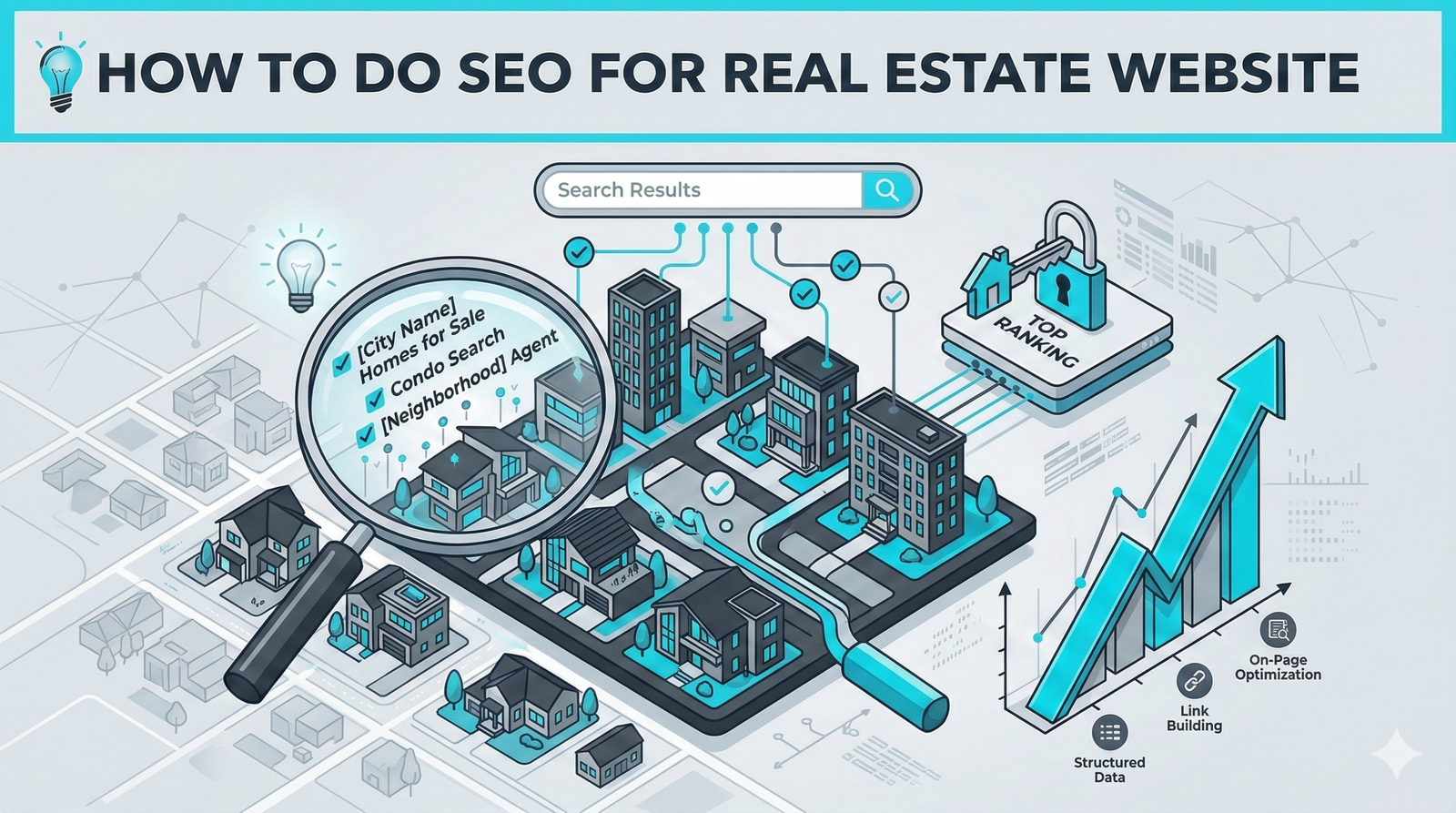
- SEO for real estate website has become more essential as the property markets have started to move aggressively. There are thousands of buyers daily who are searching online before contacting an agent. This has raised the need for real estate websites to rank higher online in order to improve their visibility. There are several real estate brands that depend on SEO professional services, and follow a detailed content marketing guide in order to improve their online presence. In this blog, we will provide you with the most important strategies that will help you to increase your online visibility, attract high-intent leads, and rank at the top of the search results.
What is SEO for real estate website
- Real estate SEO is usually different from the general SEO as it mainly consists of location-based search intent. Buyers and renters usually search for specific queries and phrases such as “Flats in California”, which makes local relevance a major ranking factor. SEO for real estate websites mainly focuses on geographically targeted keywords, accuracy of properties, trust-building signals, and high-quality listing content, in order to reassure users before they contact an agent or schedule a visit.
How to do keyword research for SEO for real estate website
- Keyword research for SEO on a real estate website mainly focuses on local intent, long-tail keywords, and buyer intent in order to target property and sellers. Real estate is an especially localized domain, so sellers will have to include specific locations like cities, surrounding neighborhoods, streets, and landmarks in keywords. Long-tail keyword usually consists of “buy 2 BHK flat in Amsterdam”, “luxury condos near Park street” or “affordable houses in Manhattan under $800K”. These targeted keywords are mainly aligned with the user intent and improve the chances of converting local customers into buyers.
On-page SEO strategies for real estate website
Keyword optimization
- Use primary and long-tail keywords and place them naturally into keyword areas like page titles, headings, meta descriptions, and throughout the content. You can also use property descriptions providing detailed features and benefits that match the search queries of buyers. By using location-specific keywords focusing on cities, neighborhoods, and property types capture the attention of local buyers.
Content quality and structure
- Creating high-quality, original content that consists of property listings, buying guides, market trends, FAQs, and neighborhood insights will improve the visibility of your website on search engine results pages. Structure the content by using clear headings for better readability and SEO. You can also use keyword clusters and answer common search questions in order to target featured snippets and voice search.
Schema markup and structured data
- By incorporating real estate schema types such as “RealEstateListing”, “LocalBusiness”, “Review”, “Visit”, and “Offer” will improve listings in search results along with rich snippets. Structured data also helps search engines to easily understand the details of a property along with business information. This further improves the click-through rates of a website.
Internal linking
- Connect all the related pages of your website, like listings, blog articles, and service pages, with the internal links. This will improve the site navigation for users and will help to distribute the link equity throughout the website.
Local SEO for real estate website
Google business profile optimization
- Create and verify your Google Business Profile for your real estate company. Make sure that you have used a consistent NAP (name, address, phone number) across all the online directories. You will also have to regularly update your business profile with current listings, hours, photos, and respond to reviews accordingly.
Localized content marketing
- Regularly publish blog posts, along with guides. This addresses local real estate trends, zoning changes, and neighborhood events. This will help you drive better engagement of your website. You can also use local keywords in your blog titles and content, which will help you to easily target a more local audience.
Local citations and directory listings
- List all your businesses accurately on local real estate directories, review websites, and local chamber of commerce websites. Focus on niche portals such as Realtor.com, Zillow, or local MLS feeds. You will also have to respond to reviews and manage them across all your platforms. This will foster trust with the buyers and establish SEO authority.
Local backlinks and partnerships
- As a relator, you need to build backlinks from local business partnerships, community events, local news websites, and sponsorships. This will help you earn a trusted reputation, interacting with local influencers and other real estate-related organizations
Location-specific landing pages
- Create dedicated pages for every city, neighborhood, or area you serve with your services. Try to include local content regarding the market, amenities, neighborhood attractions, and schools. By using local keywords naturally, you can emphasize hyperlocal terms like “Best realtors in London”.
Technical SEO for real estate website
Website speed optimization
- Compress all the images of your website, especially high-res property photos and videos, by using tools like WebP format and lazy loading in order to improve load times. You can also minimize JavaScript, CSS, and server response times. By using Content Delivery Networks (CDNs), and effective hosting services that are optimized for real estate platforms.
Clean, structured URLs, and site architecture
- Maintain short and descriptive URLs with relevant keywords such as homes-for-sale or Miami Beach. You need to ensure that there is a logical hierarchy of your website, which consists of category pages, location pages, and individual property listings. Internal linking of your website should be consistent. This will help to distribute page authority.
Schema markup for real estate
- You can also implement real-estate-specific schema types. Structured data will also help your listings to appear in rich search results with better visual features such as price, availability, ratings, and reviews.
Mobile first and responsive design
- Make sure that your website performs easily across mobile devices, as most property searches take place on mobile. Google prioritizes mobile-friendly websites for ranking, so ensure that your website has an adaptive design and touch-friendly features, which are important.
Conclusion
- SEO for real estate website is not just a one-time activity; it is a regular process that involves keyword optimization, high-quality content, link authority building, and technical improvements. When incorporated correctly, these strategies play an important role in increasing your website’s online visibility, driving high-internet buyer traffic, while also increasing sales queries.
- If you are looking for expert support in implementing these strategies, then Pentra SEO services can assist you in achieving better rankings. Our team has experience in real estate SEO, technical optimization, and strategic content planning, in order to provide the right foundation to elevate your property business online.
- Contact us, and our team will get back to you in 24 hours.

Author
Pentra SEO Agency